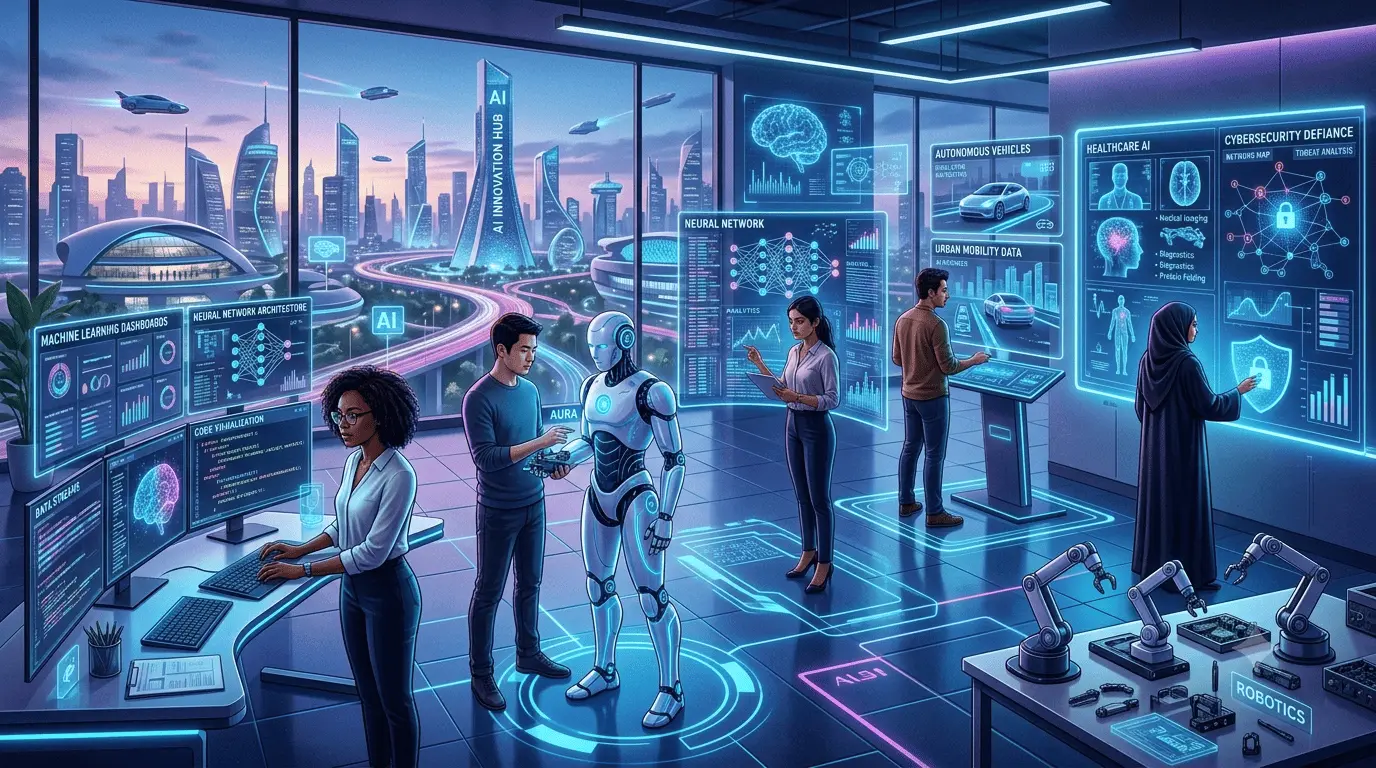
Future Career Opportunities in Artificial Intelligence
Future Career Opportunities in Artificial Intelligence: Skills, Jobs & Career Paths for 2026 and Beyond
Indroduction
Artificial Intelligence has stopped being a buzzword. It's now the infrastructure quietly running behind your food delivery app, your bank's fraud alerts, your doctor's diagnostic tools, and the ad that somehow knew exactly what you were about to search for. If you've been wondering whether Future Career Opportunities in Artificial Intelligence are worth chasing, the honest answer is yes, but with some nuance that most "AI is the future!" articles skip over.
AI is arguably the fastest-growing technology category in modern history. Unlike previous tech waves that took a decade to move from research labs to everyday business use, generative AI went from a novelty to a boardroom priority in under three years. Businesses across healthcare, education, finance, ecommerce, manufacturing, and marketing are no longer asking whether to adopt AI; they're asking how fast they can do it without falling behind competitors who already have.
This shift is creating a genuinely new job market. Roles like prompt engineer, AI product manager, and MLOps specialist didn't exist in most job descriptions five years ago. Today, jobs requiring specific AI skills are growing nearly eight times faster than the overall job market, and companies are paying a significant wage premium often 50–60% more for people who have them. In India, industry estimates suggest AI-related job postings have grown by double digits year over year, and salary growth for AI roles is outpacing traditional software engineering by a wide margin.
Whether you're a student choosing a specialization, a graduate figuring out where to start, an IT professional planning a pivot, a career changer wondering if it's too late, or a business owner trying to understand what your team should be learning this guide breaks down where the real AI job opportunities are, what skills actually matter, and how to build a practical AI career roadmap around them.
This isn't a one-size-fits-all list either. AI careers today span everything from deeply technical engineering roles to strategy, marketing, and consulting positions, which means there's a realistic entry point regardless of your current background.
What Is Artificial Intelligence, Really?
At its core, Artificial Intelligence refers to computer systems built to perform tasks that normally require human intelligence: recognizing patterns, understanding language, making predictions, and generating new content. Machine Learning (ML) is the subset of AI where systems learn from data rather than being explicitly programmed for every scenario. Deep Learning goes a level deeper, using layered neural networks to handle complex tasks like image recognition and language understanding. Generative AI, the branch responsible for tools like ChatGPT and Midjourney, creates new text, images, code, or audio based on patterns learned from massive datasets.You don't need a PhD to work in AI. Most people building careers in this space today are engineers, marketers, analysts, and even non-technical professionals who learned to work with AI tools rather than build AI from scratch.
Why AI Is the Future of Work
Every major labour-market report released in the last year points to the same conclusion: AI isn't just automating tasks; it's reorganizing entire job categories. Some studies estimate that AI and related technologies could create around 97 million new roles globally by 2027 while displacing roughly 85 million, a net gain, but one that requires reskilling because the new jobs look nothing like the old ones.
What's interesting is what is being rewarded. It's not just technical execution anymore; it's judgment, leadership, and the ability to apply AI usefully rather than just operate it. Entry-level roles in AI-exposed industries increasingly demand skills that used to be reserved for senior employees, which means the career ladder is compressing. The people who get ahead fastest are the ones who combine technical AI literacy with real decision-making ability early in their careers.
This is exactly why Artificial Intelligence jobs are showing up on "fastest-growing role" lists across nearly every major economy, not because AI replaces people wholesale, but because it changes what skills are worth paying for.
Top AI Career Opportunities to Watch
Here's a breakdown of the roles driving the most hiring activity right now, and this list also doubles as a practical AI career roadmap, since many professionals move between these roles as their skills deepen.
AI Engineer / AI Developer Builds and deploys AI systems, from chatbots to fraud detection models to recommendation engines. AI Developer is often used interchangeably with AI Engineer in job postings, and this is currently one of the fastest-growing job titles globally, with postings rising sharply year over year.
Machine Learning Engineer focuses specifically on designing, training, and optimizing ML models, and getting them into production reliably. Machine Learning careers like this one increasingly reward engineers who can handle deployment, not just model-building in a notebook.
Data Scientist Collects, analyzes, and interprets large datasets to extract business insights and build predictive models. Still one of the most consistently well-paid roles in the AI ecosystem.
Prompt Engineer Designs and refines the instructions given to large language models to get reliable, high-quality outputs. Prompt Engineering jobs are a newer discipline, but the skill is increasingly folded into broader AI engineering and product roles rather than existing as a standalone job forever.
AI Research Scientist — Works on advancing the underlying science: new model architectures, training techniques, and capabilities. Typically requires strong academic grounding and is concentrated at research labs, universities, and large tech companies.
Robotics Engineer — Combines AI with mechanical and electrical engineering to build autonomous machines used in manufacturing, logistics, and increasingly, healthcare and agriculture.
NLP Engineer — Specializes in natural language processing, the technology behind chatbots, translation tools, and voice assistants. Demand has spiked as businesses build LLM-powered products, and this is one of the Generative AI careers seeing the sharpest salary premiums right now.
Computer Vision Engineer — Builds systems that interpret images and video, used in everything from quality inspection on factory lines to medical imaging and autonomous vehicles.
AI Product Manager — Bridges the gap between technical AI capability and real business value. Since a large share of AI pilots fail to reach production, product managers who can prioritize the right features and manage the full lifecycle are in high demand.
AI Consultant — Helps businesses figure out where and how to implement AI effectively, often working across strategy, technology selection, and change management.
AI Marketing Specialist — Uses AI tools to optimize campaigns, personalize customer experiences, and automate repetitive marketing tasks a role we'll dig into more below.
AI Content Strategist — Plans and oversees AI-assisted content creation across blogs, social media, and video, balancing efficiency with originality and brand voice.
AI Automation Expert — Designs workflows that connect AI tools with business systems to eliminate manual, repetitive processes across departments.
AI Cybersecurity Specialist — Uses AI to detect threats faster and more accurately than traditional methods, while also defending AI systems themselves against manipulation and data poisoning attacks.
Skills You Actually Need for an AI Career
Forget the idea that you need to master everything at once. Here are the Artificial Intelligence skills that genuinely move the needle:
Python — the default programming language across machine learning, data science, and automation. If you learn one language for an AI career, this is it.
Machine Learning fundamentals — understanding how models are trained, evaluated, and improved.
Deep Learning — neural networks, particularly relevant for computer vision and NLP roles.
Generative AI — understanding how large language models and diffusion models work, even if you're not building them from scratch.
Prompt Engineering — increasingly a baseline skill for any knowledge worker, not just a standalone job.
Data Analysis — the ability to work with, clean, and interpret data is foundational to almost every AI-adjacent role.
Cloud Computing — platforms like AWS, Google Cloud, and Azure are where most AI systems actually get deployed and run.
APIs — knowing how to connect AI models to real applications through APIs is a practical skill that separates people who can ship products from people who can only experiment.
Mathematics — linear algebra, probability, and statistics matter more for research-heavy and ML engineering roles than for applied or product-facing ones.
Communication Skills — explaining AI capabilities and limitations to non-technical stakeholders is often what separates a mid-level professional from a senior one.
Problem Solving — AI tools are only as useful as the judgment applied to the problems they're pointed at.
AI Tools Worth Learning Right Now
Regardless of your career track, familiarity with today's leading AI tools gives you a practical edge:
ChatGPT, Gemini, and Claude — general-purpose AI assistants used for writing, research, coding, and analysis across nearly every industry.
GitHub Copilot and Cursor AI — AI coding assistants that speed up software development and are becoming standard in engineering workflows.
Midjourney and DALL·E — AI image generation tools widely used in marketing, design, and content production.
Perplexity AI — an AI-powered research and answer engine increasingly used for fast, cited information gathering.
Microsoft Copilot — embedded AI assistance across Office apps, useful for professionals who live in Excel, Word, and Outlook.
TensorFlow and PyTorch — the two dominant frameworks for building and training machine learning models, essential for anyone in an engineering-track AI role.
Learning to use these tools well not just casually, but as part of a structured workflow- is one of the fastest ways to become noticeably more productive and employable right now.
AI in Digital Marketing: A Genuine Career Frontier
Digital marketing is one of the areas where AI adoption has moved the fastest, and it's created a wave of new opportunities for people who understand both marketing strategy and AI tools. AI-powered digital marketing is no longer a niche specialty; it's rapidly becoming the default way campaigns get planned, targeted, and optimized.
AI and SEO — AI tools now help identify keyword opportunities, analyze search intent, and structure content for both traditional search engines and AI-powered answer engines. Search itself is evolving, with more users getting answers directly from AI assistants rather than clicking through to websites, which is reshaping how SEO professionals plan content.
AI-powered content creation — From first drafts to headline testing, AI tools help content teams produce more variations faster, though the best output still requires human editing for accuracy, brand voice, and originality.
AI in PPC advertising — Ad platforms increasingly use AI to optimize bidding, audience targeting, and creative testing in real time, shifting the marketer's role from manual optimization toward strategic oversight.
Social media automation — AI tools now handle scheduling, caption generation, and even initial creative concepts, freeing up teams to focus on strategy and community engagement.
AI-powered email marketing — Send-time optimization, subject line testing, and dynamic content personalization are increasingly automated, improving open and click-through rates without manual guesswork.
Customer personalization — AI analyses browsing and purchase behaviour to tailor product recommendations, messaging, and offers to individual customers at a scale that would be impossible manually.
Predictive analytics — Businesses use AI to forecast demand, customer churn, and campaign performance before committing budget, reducing wasted spend.
Marketing automation — AI now sits inside broader marketing automation platforms, triggering personalized actions based on user behavior across the entire customer journey.
AI for ecommerce in particular has moved from experimental to essential. For an e-commerce marketing agency Kerala businesses might work with, these capabilities translate into very concrete outcomes: smarter product recommendation engines that increase average order value, AI-driven customer segmentation that improves targeting precision, automated campaign optimization that reduces wasted ad spend, and predictive analytics that help online stores plan inventory and promotions around actual demand patterns. A digital marketing company in Kerala working across e-commerce, hospitality, or retail clients can use these AI capabilities to run leaner, more data-driven campaigns. Understanding what an AI marketing agency does with these tools is genuinely useful knowledge for any business owner evaluating a marketing partner, regardless of which agency they eventually choose to work with.
Salary Trends: What AI Careers Actually Pay
In India: Entry-level AI engineers typically start around ₹6–8 LPA at IT services firms, with product companies in cities like Bengaluru and Hyderabad often starting higher. Mid-career professionals (4–6 years) commonly earn ₹15–30 LPA, and senior AI architects, GenAI specialists, and MLOps leads can reach ₹40–80 LPA or more at top product companies and global capability centres. Specializations in Generative AI, LLM engineering, and MLOps consistently command a 20–45% premium over general AI/ML roles. Data scientists typically earn in the ₹15–20 LPA range at mid-career levels, and NLP specialists see similarly strong compensation. Overall, salary growth in AI roles has been running at roughly 15–20% annually, a pace well above traditional software roles.
Globally (primarily US data): AI and ML engineers generally earn base salaries between $140,000 and $200,000, with senior engineers at major tech companies and AI labs pushing past $300,000–$400,000 in total compensation once equity and bonuses are included. Generative AI specialists people who can fine-tune models and build production-grade LLM applications often command some of the highest premiums in the market. The UK shows similarly strong numbers, with AI engineers averaging well into six figures in GBP terms.
Future demand projections: Multiple industry analyses project continued double-digit annual growth in AI hiring through 2030, driven by a persistent gap between the number of AI-skilled professionals available and the number companies need. Industries hiring most aggressively include technology, financial services, healthcare, manufacturing, professional services, and increasingly, ecommerce and retail.
Future Scope of AI Across Industries
Healthcare — AI is being used for diagnostic imaging, drug discovery, and administrative automation, with adoption still catching up to genuine need given global healthcare staffing shortages.
Finance — Fraud detection, algorithmic trading, credit risk modelling, and automated customer service are already deeply embedded in the sector, with continued investment expected.
Education — Personalized learning platforms, AI tutoring tools, and automated grading are reshaping how institutions deliver and assess learning.
E-commerce — Product recommendations, dynamic pricing, chatbots, and demand forecasting are becoming standard rather than optional for competitive online retailers.
Manufacturing — Predictive maintenance, quality inspection via computer vision, and supply chain optimization are driving heavy AI skill demand in this sector, sometimes even more than in traditionally "tech" industries.
Logistics — Route optimization, warehouse automation, and demand forecasting are transforming how goods move globally.
Cybersecurity — AI-driven threat detection is becoming essential as attacks grow more sophisticated and frequent, while AI systems themselves also need dedicated security expertise.
Agriculture — Precision farming, crop monitoring via satellite and drone imagery, and yield prediction are opening up a genuinely new category of AgriTech careers.
Smart Cities — Traffic management, energy grid optimization, and public safety systems increasingly rely on AI to function efficiently at scale.
Challenges You Should Understand Before Diving In
A career guide that only talks about upside isn't giving you the full picture. A few real challenges are worth knowing:
Ethical AI — Bias in training data, lack of transparency in model decision-making, and fairness concerns are active problems the industry is still working through, not solved issues.
Job displacement concerns — Roles built around repetitive, predictable cognitive tasks like basic data entry are genuinely shrinking as automation improves. This is a real trend, not just anxiety.
Data privacy — As AI systems rely on huge amounts of personal and business data, privacy regulation and responsible data handling are becoming core parts of many AI-adjacent jobs, not side concerns.
Responsible AI — Companies are increasingly expected to build governance structures around how AI is deployed, creating new roles in AI ethics and compliance.
The need for continuous learning — Perhaps the biggest challenge: AI tools and best practices are changing so fast that skills learned two years ago can already feel outdated. A mindset of ongoing learning isn't optional in this field; it's the price of staying relevant.
Conclusion: Start Building Your AI Career Today
The Future Career Opportunities in Artificial Intelligence are not a distant promise; they're already here, reshaping industries from healthcare to e-commerce to marketing right now. What separates the people who benefit from this shift from those left behind isn't luck or timing. It's a willingness to build practical, applicable AI skills, whether that's learning Python and machine learning fundamentals, mastering prompt engineering and AI tools, or understanding how AI is transforming your specific industry, like digital marketing or e-commerce.
You don't need to master everything at once. Pick one skill area that aligns with where you already have strength technical, creative, analytical, or strategic and start building from there. The window for getting ahead of this shift is still open, but it's narrowing as more professionals catch on. The best time to start learning AI was a year ago. The second-best time is today.
Frequently Asked Questions
Is Artificial Intelligence a good career in 2026?
Yes. AI-related job postings and salaries are growing significantly faster than the overall job market, and demand spans far beyond tech companies into healthcare, finance, manufacturing, and marketing.
Which AI job has the highest salary?
AI Research Scientists, senior Machine Learning Engineers, and Generative AI/LLM specialists tend to command the highest salaries, particularly at large tech companies and AI-focused labs.
What skills are required for AI careers?
Core skills include Python, machine learning fundamentals, data analysis, and problem-solving, along with growing importance placed on communication skills and business judgment.
Can beginners start a career in AI?
Yes. Many people enter through adjacent roles like data analysis, digital marketing, or software development and build AI skills gradually through courses, certifications, and hands-on projects.
Is coding mandatory for AI jobs?
Not for every AI-related role. Engineering and research roles require coding, typically in Python, but roles like AI marketing specialist, AI consultant, or AI content strategist rely more on understanding AI tools and strategy than writing code.
Which AI tools should I learn first?
Start with a general-purpose assistant like ChatGPT, Gemini, or Claude to build comfort with AI workflows, then move into specialized tools relevant to your field, such as GitHub Copilot for coding or Midjourney for design.
How is AI changing digital marketing?
AI is automating campaign optimization, personalizing customer experiences, generating content drafts, and improving predictive analytics, shifting marketers' roles toward strategy and oversight rather than manual execution.
Can AI improve ecommerce businesses?
Yes. AI helps ecommerce businesses with product recommendations, customer segmentation, dynamic pricing, chatbots, and demand forecasting, often leading to measurable improvements in conversion rates and average order value.
What industries hire AI professionals?
Technology, finance, healthcare, manufacturing, e-commerce, logistics, cybersecurity, and professional services are among the biggest employers of AI talent today.
Which certification is best for AI careers?
Cloud-specific certifications like AWS Certified Machine Learning Specialty, Google Cloud Professional ML Engineer, and Microsoft Azure AI Engineer are widely recognized and valued by employers, especially when paired with a strong project portfolio.
Do I need a degree to work in AI?
A formal degree helps for research-heavy roles, but many applied AI roles, especially in marketing, product, and automation, increasingly value demonstrated skills and portfolio projects over formal credentials alone.
How long does it take to build a career in AI?
It varies by starting point, but many professionals build job-ready foundational skills within 6–12 months of focused learning, while deeper specialization in areas like ML engineering or research can take several years of continuous study and practice.

KOCHI
- Tapclone, House no: 32/2517A
- PJ Antony Rd,Sonia Nagar,Palarivattom,
- Kochi,Ernakulam , Kerala - 682025
- Email : info@tapclone.in
- Ph: +0484 796 5300 Mob: +91 9037 833 933
CALICUT
- Tapclone, Fortune Business Park,2nd Floor,
- Cherooty Nagar,Asokapuram,Calicut-673006
- Ph : 0495 460 5549 Mob: +91 9037 833 933